Remembering those who fought for their countries, those who aren't here and those who are.
My father is a veteran of WW II and I am so proud of him. He had just turned 18 when President Roosevelt called him to service for his country and he was sent from Brooklyn to Fort Bragg, and then overseas to Germany as a medic to help Germany recover/clean up from the war.
He won't talk about it and he still has nightmares about what he saw. They called it shell shock back then, today it's called PTSD. Those who know me know my dad is my my hero and who taught me what men should be like, just like all fathers do with their daughters.
My mother had an Uncle she never met who was killed at the Second Battle of the Marne during World War I.
I know I have several readers who have husbands who have served recently and a friend who currently has a son over there. One of my dearest friends in the world recently completed 20 years with the Guards.
Several years ago I was in London on the 11th of November, in front of the Centotaph and saw the Queen put a wreath on it. I cried. So did the people I was with. We later went to Westminster Abbey and laid a cross in memory of my friends grandfather who died in WW I as well.
I know people look at tomorrow as just another day to shop the sales before Christmas, but please, take a moment and thank those who served to make our lives better and give us freedom. They shan't be forgotten. Do a good deed for a Veteran. Tell them thank you.
Here's a clip from one of my favorite TV shows of all time, Blackadder, that commemorates WW I. Lest we forget. And yes, that is House in it.
Wednesday, November 10, 2010
Sunday, November 7, 2010
Rerun:Some Early Thoughts on Anatomy of an Epidemic
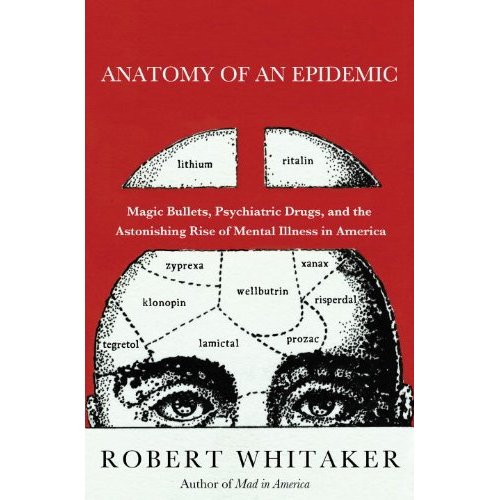
It's come to my attention that a lot of controversy has been generated lately by certain bloggers over Robert Whitaker's book Anatomy of an Epidemic. Let me put it this way. In my life time, I will rank it as one of the best non fiction books I have ever read, the other one being "And the Band Played On". I hope Mr. Whitaker's book does for the mental health movement what Shilt's book was able to accomplish for the gay movement. Here is my review of Whitaker's book. If you haven't bought any holiday presents, I would consider purchasing this one as a gift.
Robert Whitaker's latest book "Anatomy of an Epidemic" came out last month. I had been listening to it on tape (Audible) since I have problems reading print at the moment. Yesterday, the blessed package came from Amazon. His new book, and the reissue of "Mad in America".
I made myself a sandwich, poured a glass of ice tea from the fridge, and sat down, to read it again. And from the minute I started, I realized one thing. The publisher made a huge mistake. The book should come with Kleenex.
Like the spoken edition- which is the same book - it's the type of non fiction book that will make you cry. Weep, copiously. And after your tear ducts are dry, I felt like I was watching one of my all time favorite movies- "Network", living the "Mad as hell" scene. I would have indeed gone to the window and shouted, but my downstairs neighbor is 88 and deaf, and ... what good is shouting "I'm mad as hell" if no one can hear you?
I'm too numb right now, and it's 5 am in the morning to sit down and write a review worthy of the New York Times Book Review. Let's just say this.
In the book he interviews many, many people, especially in the last page. I am fortunate thanks to Facebook, to have emailed some of them and they inspire me.
And I think about the ones in the book as true cases, especially the children, who were also hurt and maimed. Including the one I love the most- ME. In the fact that we were not killed outright but, as a friend said in a phone call, - "our brains were raped".
I don't know who is pro-Big Pharma or against it, and frankly it isn't salient here. What I want everyone who sees this is to arm themselves with knowledge, every time they get a script from the doctor. The doctor can be your GP, Gynecologist, Dentist, or Shrink. You get a script, ask what this is. What are the side effects. Please ask. Go home and look up the drug on the Internet. Knowledge is important. Don't be a sheeple. This can save your life.
I was brought up by a father who worked for Big Pharma, and believed in Whitaker's "Magic Bullets". You take the script from the doctor, and take it. No questions asked. Doctors are just a fraction below G-d. If you don't question , you really are taking Blue and Red Pills. Within ten miles from where I grew up, and about 3 miles from where I am now, is a town called "Milltown". My mother always beamed with pride as she reminded her girls in the back seat of the car this town we were driving through was named after a wonderful drug from the 50s. (Whitaker describes the town and the drug in detail in the book as well).
I had only one doctor who, upon giving me a script for Lamictal back in 2001, told me about the rash. If I get any kind of rash, call him immediately. If I cannot reach him, go to the emergency room. No other doctor, from childhood on, ever did this.
The first drug I ever had a problem with was Prozac, which I started in 87, about 12 months after I was diagnosed. Prozac was was the wonder drug of that age- on the cover of Newsweek and The New York Magazine at the same time. The side effects were awful. I couldn't sleep, I had nightmares. Then the fevers, ringing in my ears, and the sensation my skin was moulting and I couldn't stop scratching. My whole personality changed, I went from being a mild Casper Milquetoast type person to someone looking for a girl fight. Then I was told to quit the drug cold turkey, and fortunately, for me, I was put on both Zoloft, and later, Paxil, and fortunately, no side effects. Not like the Prozac.
It wasn't until I was reading this book I saw i was not alone with side effects from Prozac that I experienced. And when I told the doctor how I was feeling on it, he told me to keep staying on it, and ride it out. Two psychiatrists later, I was finally moved off Prozac to something else.
And now I sit, 2 years ago almost dying from Haldol, where every muscle in my body fell asleep and I had to re-learn how to do everything. Walk, talk,eat, even go to the bathroom. Yet in the book, over and over again- Haldol- muscle fatigue. I was as bad a case from this as possible, the worst would have been dying. I survived. I wouldn't wish this on my worst enemy. To this day I am haunted by something a nurse told me when my muscles started to wake, that my screams from the pain were exactly like the ones from burn victims.
Three years ago, one P-doc put me on Remeron. After about two weeks on that I got so suicidal I checked myself into the hospital, because I reckoned, I would rather be shot up with Thorazine and be alive and get off this drug then stay home and I know I would suicide. While I was detoxing off Remeron, the same pdoc wanted to put me into Trenton Psychiatric Hospital due to the side effects I was experiencing with the meds. I fired him, and left the hospital against doctors orders. Alive. If I was put in Trenton Psych, I fear I would still be there, like a scene from "Cuckoo's nest"
And being on lithium, since 87- with small respites on Depakote and Lamictal- well, I just wrote about loosing my hair. I am constantly sick to my stomach, and can only eat bland food. Anything spicy- no. Nexium has become a magic pill for me to be able to eat anything. But the worst- is knowing that sometime between now and September I have to go for another bone marrow biopsy, and it's just a matter of time before I have leukemia unless by some miracle my white blood count should stop duplicating and go DOWN. Which it hasn't since 2003, it's been going up in some kind of Mathusian equation I haven't been able to crack.
I said this book belongs on every one's bookshelf. It does.This book deserves to be on the Times Top Ten list. But no matter your stance- pro pharma, anti pharma know this. But please, question the doctor for everything. Don't be blind trust, there are good ones and bad ones out there- but you are the most important person in the world, and you must know every option out there, and question. Likewise, there are good drugs out there- Penicillin, for example has saved lives. But question. Question everything. Question authority like you haven't done since you are 18-19. The life you save will be your own, your husbands, child's or parents. You owe them and yourself the chance to live long and prosper.
.
Saturday, October 30, 2010
On Halloween: 5 Emotional Vampires -- and How to Combat Them
I want to thank my friend Therese Bouchard for this Halloween gem. I've met a few emotional vampires in my life too. I would rather have the ones from Twilight, no? Happy Halloween, to all.
In the spirit of halloween, I thought you'd all appreciate some vampire talk. In her new book, "Emotional Freedom," UCLA psychiatrist Judith Orloff identifies five kinds of vampires that are lurking around and can zap our energy if we're not careful. Here is an excerpt adapted from her book.
Emotional vampires are lurking everywhere and wear many different disguises--from needy relatives to workplace bullies. Whether they do so intentionally or not, these people can make us feel overwhelmed, depressed, defensive, angry, and wiped out.
Without the self-defense strategies to fend them off, victims of emotional vampires sometimes develop unhealthy behaviors and symptoms, such as overeating, isolating, mood swings, or feeling fatigued.Here are five types of emotional vampires you're likely to encounter, and some "silver bullet" tips for fending them off.Vampire 1: The Narcissist.This vampire is grandiose, self-important, attention hogging, and hungry for admiration. She is often charming and intelligent--until her guru status is threatened.Self-defense tips: Enjoy her good qualities, but keep your expectations realistic. Because her motto is "me-first," getting angry or stating your needs won't phase her. To get her cooperation, show how your request satisfies her self-interest.Vampire 2: The Victim.This vampire thinks the world is against him, and demands that others rescue him.Self-defense tips: Don't be his therapist, and don't tell him to buck up. Limit your interactions, and don't get involved in his self-pity.Vampire 3: The Controller.This vampire has an opinion about everything, thinks he knows what's best for you, has a rigid sense of right and wrong, and needs to dominate.Self-defense tips: Speak up and be confident. Don't get caught up in bickering over the small stuff. Assert your needs, and then agree to disagree.Vampire 4: The Criticizer.This vampire feels qualified to judge you, belittle you, and bolster her own ego by making you feel small and ashamed.Self-defense tips: Don't take what she says personally. Address a misplaced criticism directly. Don't get defensive. Express appreciation for what's useful. Bounce back with a massive dose of loving-kindness.Vampire 5: The Splitter.This vampire may treat you like his BFF one day, and then mercilessly attack you the next day when he feels wronged. He is often a threatening rageaholic who revels in keeping others on an emotional rollercoaster.Self-defense tips: Establish boundaries and be solution-oriented. Avoid skirmishes, refuse to take sides, and avoid eye contact when he's raging at you. Visualize a protective shield around you when you're being emotionally attacked.
Wednesday, October 27, 2010
Lemons, Luck and Lemonade
I wish I had written this, but I didn't. It was written by friend of mine, Sean, a fellow journalist and writer in Tacoma, Washington
Many of the bpers I've met seem to fall into a few categories.
Some:
1) embrace their illness and try to find the positive in it (turning lemons into lemonade)
2) try their best to live with it, despite the challenges (striving to turn lemons into lemonade, sometimes more successfully than at other times)
3) are simply resigned to it (knowing they've got lemons, but believing there is nothing they can do about it
4) fight it (wishing the lemons weren't there, but since they are, hoping the lemons will turn themselves into lemonade)
5) deny it ("What lemons?")
I realize this is a gross oversimplification and doesn't take into account financial circumstance, trust in pdocs, mixed dxes, level of functioning, severity of episodes and so forth. But when I look at that list, I can't help but wonder if the primary distinction between each of the items is a bper's attitude toward his or her illness. If it is, there's good news: Attitude is the result of a choice that we are free to make.
I had a professor who survived a concentration camp, where he was subjected over an extended period to the most painful medical experiments imaginable. During one of the most excruciating experiments, he found he had suddenly stopped caring about the pain.
The pain didn't go away, obviously, but it became more bearable because it taught him that there was a part of his character that the Nazis could never reach: his attitude toward his treatment, and that was fully in his control. He later described that realization as the most liberating moment in his life. Despite barbed wire, attack dogs, crematorium and armed guards, he never felt more free in his life.
My epiphany in this regard came in a far more benign environment -- at work. I was never a morning person, so I didn't especially like getting up and going to work each day. I also have a limited theshold for idiocy not of my own making, and hated stupid obstacles created by others and got easily frustrated.
One day, the business' head honcho asked me how I could possibly go through life with such an outlook. The way he looked at things, we get a finite number of days in our lives, and he couldn't understand how a person could stand to waste a single one. (I think his attitude was shaped in part by the fact that he'd lost several siblings when they were young.) He said he couldn't wait for the alarm to go off every morning so that he could get to work and tackle the challenges.
Scott Carson
He didn't see problems the way most of us do. I remember early one morning, when I could tell by the tension in his jaw that he'd just been on the receiving end of a particularly unpleasant telephone call with a corporate honcho. I said something like "Well, it doesn't look like your day is off to a great start!"
He looked to me as if I was nuts. From his perspective, that phone call brought him an unexpected problem that would require him to use intelligence, creativity and working with others to solve. That was NOT the attitude I brought to my work and my life, but over the course of the four years I worked with him his attitude rubbed off on me and others around him.
Realizing that we control our attitudes can give us a whole new way of looking at ourselves and the world. It changes EVERYTHING. Because of that change in perspective, I found myself feeling downright LUCKY when I was dxed with bp.
Lucky that there was now an explanation for my chronic depressions, my manic antics and my abusive behavior.
Lucky that bp was treatable, and that I lived in a time when medications could bring it under control.
Lucky that it brought me in contact with other bpers, both here and IRL.
Lucky that, because of bp, I had to face and learn to overcome challenges that other people would never know.
Once I thought of myself as lucky for such a dx, I became free to feel a sense of pride in achieving even the simplest everyday task during a depressive episode. Sometimes just crawling out of bed requires a good deal of willpower, when all my body wants to do is sleep, and knowing that I really won't feel like doing any of the things I need to do once I get up. So getting up can be a significant achievement.
I feel lucky to have such supportive friends here on MG who gave me such encouragement when I was on the downslope recently, and who show appreciation on those occasions when I can contribute something of value to them. I would never have had such friends except for bp, and my life would be so much the poorer.
It takes courage to be a bper. It takes resilience. But it needn't require resignation. I like to believe it is possible for many of us to embrace our illness, appreciating the advantages it's given us and looking for ways to mitigate the disadvantages. If we've been given a lot of lemons, we may not be able to make a lemon-chiffon pie, but lemonade may be within our reach.
We don't get to choose bper-hood. But as my professor observed, we are free to choose the attitude we wish to bring to any situation, no matter how terrible. And that, in his view, is the very definition of freedom. Our attitude is within our control, and we can make a tremendous difference in our lives if we exercise that choice.
Wednesday, October 20, 2010
Shocktober
I am here. This last fortnight I have been running a fever of 100-101 every day. My joints hurt. The last two days I cannot move my legs or barely walk. I can barely get down the stairs in my apartment. I've been sleeping about 18 hours a day. When I am not sleeping I feel miserable.
I haven't been on line. I haven't been reading, or writing, I just feel too ill to do that. On top of that my hair is coming out in clumps, my fingernails, always strong, are breaking, and my skin keeps flaking off like my mother might have been an alien from "V".
I spent the morning with my GP getting blood drawn. They are testing now for Lyme's, Mono and of course my wbc for Leukemia, to see if it has gone full blown.
I am scared. I really am.
And I am sorry for not blogging or visiting any blogs. I love writing and reading others, as well as books and I am just feeling too poorly to do anything.
I should know in a few days what is going on and hopefully will be on the mend soon.
I haven't been on line. I haven't been reading, or writing, I just feel too ill to do that. On top of that my hair is coming out in clumps, my fingernails, always strong, are breaking, and my skin keeps flaking off like my mother might have been an alien from "V".
I spent the morning with my GP getting blood drawn. They are testing now for Lyme's, Mono and of course my wbc for Leukemia, to see if it has gone full blown.
I am scared. I really am.
And I am sorry for not blogging or visiting any blogs. I love writing and reading others, as well as books and I am just feeling too poorly to do anything.
I should know in a few days what is going on and hopefully will be on the mend soon.
Monday, October 11, 2010
Musings on Bipolar and Gastronomy from a Writer in South Africa
I love Mary, who blogs at Letting Go, and writes about life in South Africa. I missed this gem last week, but it's worth reprinting for two reasons. First she writes about a meal she had at La Bulli, which was for years rated the best restaurant in the world. Then she muses on a book by David Healy that starts with the untimely death of Rebecca Riley, and wonders, which came first, the condition or the drug? I will let this one speak for itself. Mary doesn't usually write about this topic but when she does, she has an interesting perspective from a country not to many people write from. Like Mary, it's a keeper.
Thank you Mary, as always.
The village encased in blank walls of heavy mist, a cow mooing somewhere out of sight. A friend has shared bunches of fresh fenugreek and handfuls of broad beans with me, so I am cooking up a storm.
And I am reading reviews of Colman Andrews’ biography of the molecular gastronomc chemistry schoolboy aka chef Ferran Adria. Years ago I ate at La Bulli in between rereading Cervantes’ Don Quixote and revisting battle sites of the Spanish Civil War. Aside from the haughtiness and inscrutability of uncommunicative macho waiters, I was astonished by a seagreen foam of what had once been plump ripe olives and perhaps a crust of Parmesan. It tasted delicious, but I was left with the impression of having eaten nothing at all. After a ravishing and improbable meal of six minute, invented dishes (including a gritty spoonful of frozen foie gras dust) I went out in my trim little bullfighter’s cape of scarlet and black and gobbled up tapas of manchego cheese, coddled eggs and chorizo, grilled anchovies, a creamy almond soup spiked with garlic. Spanish food is very more-ish.
The secret to Ferran Adria’s success? “His tongue is bigger than ours. He literally has a larger tongue than normal, with more papillae.” That may be so, but my appetite is much bigger than Ferran’s.
So good to be online again, my busy real life has gone into hiatus. Big Pharma watch from the London Review of Books, a hard look at the contested and unreliable history of bipolar disorder and the increasingly drastic treatments:
One now speaks of a ‘bipolar spectrum’, which includes, along with bipolar disorders I and II, cyclothymia (a mild form of bipolar II) and bipolar disorder ‘not otherwise specified’ (an all-purpose category in which practically any affective instability can be placed). The spectrum also includes bipolar disorders II1⁄2, III, III1⁄2, IV, V, VI, and even a very accommodating ‘subthreshold bipolar disorder’.
The category has expanded so much that it would be difficult to find anyone who couldn’t be described as ‘bipolar’, especially now that the diagnosis is liberally applied to people of all ages. Conventional wisdom once had it that manic depression burns out with age, but geriatric bipolar disorder is now the talk of psychiatric congresses. Elderly people who are depressed or agitated find themselves diagnosed with bipolar disorder for the first time in their lives and are prescribed antipsychotics or anticonvulsants that have the potential to drastically shorten their life expectancy: according to David Graham, an expert from the Food and Drug Administration, these psycho-tropic medications are responsible for the deaths of some 15,000 elderly people each year in the United States.
Scary stuff! Time to give the Internet a break and do some gardening before the sun burns off the mist and it becomes too hot outdoors. The thing about sobriety is that we get to choose what happens each day and how we respond. Something else to be grateful for –
Thank you Mary, as always.
Sunday, October 10, 2010
I think I am way over due for a cute fix
I am way over due for a cute fix. Something cute to take our minds off the world news, and just make you feel happy.
Enjoy your weekend, and remember, somebunny, (Me) loves you.
Friday, October 8, 2010
A Brand New Blog Worth Reading
I've been writing about old psychiatric hospitals the last few entries, for the same reason that Santayana said to recall history. So it's not repeated. So people when hospitalized won't suffer like our ancestors did.
With that in mind, I am pleased to announce that long time activist Jonathan Dosick has started a blog, Civil Rights in Psychiatric Hospitals.
I am breaking one of my cardinal rules, I don;'t promote brand new blogs having been burned by brand new bloggers I start reading and they stop blogging after a month or so. If you are a blogger and you want on my blog roll, my requirements are 1. You gotta be blogging for three months, and 2, I have to like reading you. I don't have to agree with you but I have to enjoy reading you.
Jonathan has been an advocate in Massachusetts for a very long time. Here is Jonathan's mission: i snded in dis
This is one not only do I enjoy but it's a must and should be on our blog rolls. To stay in the loop about what goes on and how to change it. Because Jonathan is an awesome activist. It's tough to read, but a little bit of knowledge goes a long way and might come in handy for a loved ones hospitalization. Not every hospital is bad. But so many ones are and with so many budget cuts, a little knowledge does go a long way.
With that in mind, I am pleased to announce that long time activist Jonathan Dosick has started a blog, Civil Rights in Psychiatric Hospitals.
I am breaking one of my cardinal rules, I don;'t promote brand new blogs having been burned by brand new bloggers I start reading and they stop blogging after a month or so. If you are a blogger and you want on my blog roll, my requirements are 1. You gotta be blogging for three months, and 2, I have to like reading you. I don't have to agree with you but I have to enjoy reading you.
Jonathan has been an advocate in Massachusetts for a very long time. Here is Jonathan's mission: i snded in dis
We must address the continuing climate of disrespect, coercion and disempowerment that we see daily at inpatient facilities. This is carried out in the name of patient safety, but is grounded in discrimination, ignorance and the relentless pursuit of Profit.
The hospital lobbyists who furiously oppose our efforts claim that State authorities should not dictate clinical care - but their dismal record regarding basic patient rights shows that they need oversight.
In the mental health system, why is 'clinical care' so misunderstood? Why, in the name of 'proper clinical care,' are basic civil liberties and the dignity of so many violated so brazenly?
This is one not only do I enjoy but it's a must and should be on our blog rolls. To stay in the loop about what goes on and how to change it. Because Jonathan is an awesome activist. It's tough to read, but a little bit of knowledge goes a long way and might come in handy for a loved ones hospitalization. Not every hospital is bad. But so many ones are and with so many budget cuts, a little knowledge does go a long way.
Thursday, October 7, 2010
Guest Post: Understanding Through Reading 3 Must-Read Memoirs on Biopolar
As anyone who has suffered bipolar disorder, schizophrenia, or other related disorders knows, it's more difficult to live with than other illnesses because it affects you and everyone you know. While chronic physical disorders don't necessarily change your behavior, chemical imbalances in the brain make it a daily struggle to maintain healthy relationships because behavior is unpredictable. Your friends and family, try though they might, just don't understand. And this lack of understanding is precisely what causes these strains in interpersonal relationships in the first place.
Reading about those who have struggled with bipolar disorder is a helpful way of gaining a new understanding and perspective. Everyone has different ways of dealing with the disease, and it can be inspirational to find others who understand, and who can articulate their personal stories. Here are a few memoirs that are particularly noteworthy:
Kay Jameson is probably the leading researcher on bipolar disorder. As both a psychiatrist and a sufferer of bipolar disorder herself, Jameson offers insight into the illness that both personal and professional. Jameson, although critical of big pharma, does demonstrate how a combination of lowered medication and personal support saved her life. Best of all, Jameson clues us in on the latest advances in neuroscience that can offer new hope for an illness that has been misunderstood and misdiagnosed for centuries.
We all know Kurt Vonnegut, the eminent writer who gave us such classics as Cat's Cradle and Slaughter House Five. But what many don't know is that his son, Mark, struggled under his father's shadow with a debilitating bout of decades-long psychosis that was first diagnosed as schizophrenia but what he now considers bipolar disorder. In his latest volume, released this year, Vonnegut offers fascinating insight into his own struggles, as well as giving readers a more expansive perspective on mental illness in general. With panache and humility, Vonnegut is adept at both writing humorously and inspirationally. In one of my favorite segments, Vonnegut states:
"None of us are entirely well, and none of us are irrevocably sick. At my best I have islands of being sick entirely. At my worst I had islands of being well. Except for a reluctance to give up on myself there isn't anything I can claim credit for that helped me recover from my breaks. Even that doesn't count. You either have or don't have a reluctance to give up on yourself. It helps a lot if others don't give up on you."
While Jameson's book is told from the perspective of a clinician, and Vonnegut's is told from both the perspective of a doctor and the son of a famous writer, Manic is written by a former entertainment lawyer. The most interesting part about Manic is that Cheney writes her book in short episodic segments that very accurately describe what it's like to cycle from the rapid highs to the soul-wrenching lows that characterize bipolar disorder. Cheney's account is not necessarily an uplifting one, but it's certainly describes the bipolar life with a candor that is hard to match.
These are just a few memoirs out there about individuals who have learned with varying degrees of success to live in the rollercoaster existence of bipolar. Even if they don't offer hope per se, they at least offer solace. Knowing you are not alone in your suffering can sometimes be more uplifting than anything.
By-line:
This guest post is contributed by Kitty Holman, who writes on the topics of nursing schools. She welcomes your comments at her email Id: kitty.holman20@gmail.com.
***This is a guest post. The views and ideas expressed in this post are not necessarily the same as the author of this site. Please direct any comments or questions to the author of the post at kitty.holman20.gmail.com.
Tuesday, October 5, 2010
More Hell on Earth-Norwich Mental Hospital
I have been trying for over a year to find this clip and put it on my blog. The best I can do is this Hulu Clip, it starts at the right counter, and it finishes at counter 31.11.
From Life After People, Second Season, episode Crypt of Civilization. We need to know about these things so they will never happen again.
I bring you Norwich Mental Hospital, otherwise known as Norwich State Hospital for the Insane, in Preston and Norwich, CT, USA
Clip contains triggers
Eta: I apologize about the ads.
From Life After People, Second Season, episode Crypt of Civilization. We need to know about these things so they will never happen again.
I bring you Norwich Mental Hospital, otherwise known as Norwich State Hospital for the Insane, in Preston and Norwich, CT, USA
Clip contains triggers
Eta: I apologize about the ads.
Subscribe to:
Posts (Atom)